Life in Hydrothermal Vents: Earth's Hidden Worlds
/ 7 min read
Table of Contents
Unveiling Earth’s Deep-Sea Oases
Beneath miles of crushing ocean water, in realms where sunlight never penetrates and temperatures fluctuate wildly, lie some of Earth’s most alien yet vibrant ecosystems: hydrothermal vents. These geological marvels, first discovered in 1977 by the research submersible Alvin in the Galápagos Rift, shattered our understanding of where and how life could thrive. They revealed hidden worlds teeming with unique creatures, completely independent of the sun’s energy, offering a profound glimpse into life’s incredible adaptability and resilience.
What are Hydrothermal Vents?
Hydrothermal vents are essentially underwater hot springs formed along volcanically active regions of the seafloor, primarily at mid-ocean ridges where tectonic plates pull apart. Here’s how they form:
- Crustal Fissures: Seawater seeps through cracks and fissures in the oceanic crust.
- Magma Heating: As the water penetrates deeper, it comes into contact with superheated magma chambers beneath the seafloor. The water can reach temperatures exceeding 400°C (750°F), far above its normal boiling point due to the immense pressure at these depths.
- Chemical Exchange: The superheated water reacts with the surrounding rocks, dissolving minerals and metals like iron, copper, zinc, and sulfur.
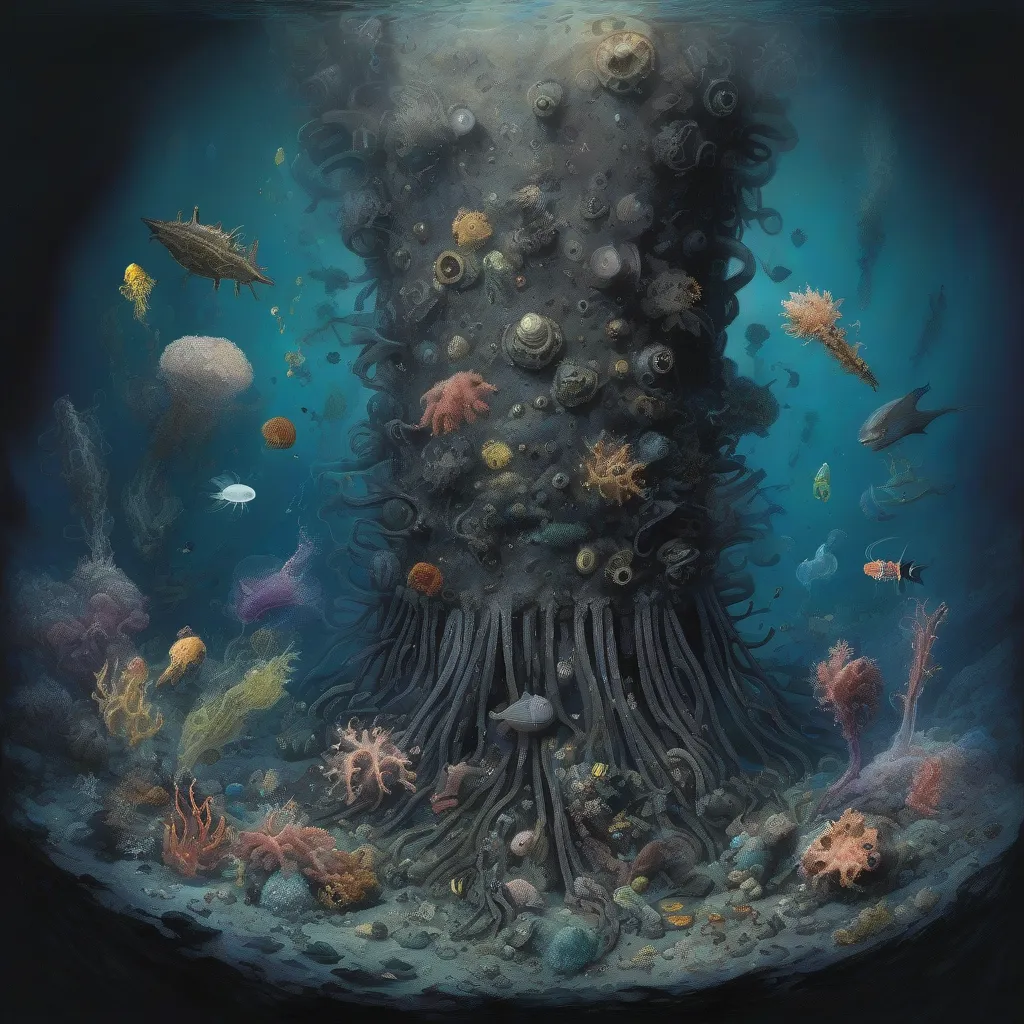
- Eruption: This mineral-rich, superheated water then rises back to the seafloor through vent chimneys. As it mixes with the cold, oxygen-rich deep-sea water, the dissolved minerals precipitate out, forming towering structures, sometimes dozens of meters tall.
There are two main types of hydrothermal vents:
- Black Smokers: These vents emit plumes of dark, mineral-laden water, rich in iron sulfides, giving them their characteristic “smoke” appearance. They are typically the hottest vents.
- White Smokers: Emitting lighter-colored plumes, often rich in barium, calcium, and silicon, these vents are generally cooler than black smokers, though still far hotter than the ambient deep-sea environment.
Chemosynthesis: The Engine of Life
One of the most astonishing discoveries about hydrothermal vent ecosystems is their complete independence from sunlight. On the surface, life is powered by photosynthesis, which uses sunlight to convert carbon dioxide and water into energy. In the abyss, however, a different process reigns: chemosynthesis.
Chemosynthesis is a biological process where organisms convert inorganic chemicals into organic matter, effectively creating food from chemical energy. The primary energy source at hydrothermal vents is hydrogen sulfide (H₂S), a chemical compound that is toxic to most surface life.
- Bacterial Foundation: Specialized chemosynthetic bacteria and archaea form the base of the vent food web. They oxidize hydrogen sulfide and other chemicals (like methane, iron, and manganese) to produce energy, much like plants use sunlight.
- Symbiotic Relationships: Many larger vent animals don’t consume these bacteria directly. Instead, they form remarkable symbiotic relationships. For instance, the iconic giant tubeworms (genus Riftia) have no mouth or digestive tract. They host billions of chemosynthetic bacteria within a specialized organ called a trophosome. The tubeworm absorbs hydrogen sulfide and other chemicals from the water, transports them to the bacteria, and in return, the bacteria provide the tubeworm with organic nutrients.
This chemical-based energy system supports an entire ecosystem in an environment that was once thought to be barren.
The Diverse Inhabitants of Vent Ecosystems
The life around hydrothermal vents is nothing short of extraordinary, with creatures exquisitely adapted to their harsh surroundings.
- Giant Tubeworms (Riftia pachyptila): Perhaps the most famous vent dwellers, these striking, red-plumed worms can grow over 2 meters (6.5 feet) long at an astonishing rate of up to 85 cm per year, making them one of the fastest-growing invertebrates. Their vibrant red plumes are due to hemoglobin, which binds oxygen and hydrogen sulfide and transports them to their internal bacterial partners.
- Pompeii Worms (Alvinella pompejana): Named for their incredible heat tolerance, these fuzzy, segmented worms are found living on the walls of black smoker chimneys, often enduring temperatures between 20°C (68°F) and 80°C (176°F) simultaneously. They also harbor bacteria on their backs, which are thought to provide insulation or detoxification.
- Vent Mussels and Clams: These bivalves, like the tubeworms, often host chemosynthetic bacteria in their gills, thriving on the chemical bounty. They can form dense beds, covering vast areas around vents.
- Deep-Sea Shrimp and Crabs: Various species of shrimp, some with light-sensing organs on their backs (even though there’s no visible light), graze on bacterial mats or prey on smaller vent fauna. Crabs, often heavily armored, are also common scavengers and predators.
- Octopuses and Fish: While less common than invertebrates, a few species of deep-sea octopuses and fish, such as the Vent Scaleless Fish, have been observed around vents, preying on other vent inhabitants.
The biodiversity at some vent fields can be surprisingly high, with unique species found at different vent sites across the globe, indicating a high degree of endemism. It’s estimated that over 90% of the species discovered at hydrothermal vents are new to science.
Global Hotspots: Iconic Vent Communities
Hydrothermal vents are found in all of the world’s oceans, though specific characteristics and communities can vary.
- Galápagos Rift (East Pacific Ocean): The site of the initial discovery in 1977, this region is famous for its towering white smokers and expansive fields of giant tubeworms and clams.
- East Pacific Rise (Pacific Ocean): Known for its incredibly active black smokers and diverse communities of tubeworms, shrimp, and scale worms. Many new species continue to be discovered here.
- Mid-Atlantic Ridge (Atlantic Ocean): Home to sites like the “Lost City” hydrothermal field, which is unique for its exceptionally tall, carbonate-rich chimneys that can reach heights of 60 meters (200 feet). Its chemical processes are driven by serpentinization (a reaction between seawater and mantle rocks) rather than direct volcanism, supporting different microbial communities.
- Southern Ocean (Antarctica): Recent expeditions have revealed vent fields in the cold waters surrounding Antarctica, showcasing adaptations to both extreme heat and freezing ambient temperatures.
Why Study These Hidden Worlds?
The ongoing exploration of hydrothermal vents offers invaluable insights across multiple scientific disciplines:
- Origins of Life on Earth: Many scientists hypothesize that life on Earth may have originated in similar chemically-rich, energy-abundant deep-sea environments, rather than shallow sunlit pools. Vent systems provide a living laboratory to study these primordial conditions.
- Extremophiles and Biotechnology: The organisms thriving in vents are extremophiles – they tolerate extreme temperatures, pressures, and chemical concentrations. Studying their unique enzymes and biochemical pathways could lead to breakthroughs in biotechnology, medicine (e.g., new antibiotics, anti-cancer agents), and industrial processes (e.g., heat-stable enzymes for detergents).
- Astrobiology and Extraterrestrial Life: Hydrothermal vents are considered strong analogues for potential life-supporting environments on other celestial bodies, such as the subsurface oceans of Jupiter’s moon Europa or Saturn’s moon Enceladus. Understanding vent ecosystems on Earth helps us formulate strategies for detecting life beyond our planet.
- Ecosystem Resilience and Connectivity: These isolated “islands” of life teach us about the dispersal mechanisms of deep-sea larvae and the resilience of ecosystems in the face of extreme conditions, contributing to our understanding of global ocean currents and ecological connectivity.
- Mineral Resources: Vent chimneys are rich in valuable metals like copper, zinc, gold, and silver. This has unfortunately led to growing interest in deep-sea mining, raising significant environmental concerns about destroying these fragile and unique habitats.
Threats and Conservation
Despite their remote locations, hydrothermal vent ecosystems are not immune to human impact. The nascent deep-sea mining industry poses a significant threat, as the removal of active and inactive vent chimneys would devastate these unique, slow-growing communities. Climate change also presents potential risks, as changes in ocean chemistry, such as ocean acidification, could impact the shell-forming organisms and the delicate balance of chemical reactions.
Protecting these extraordinary deep-sea environments is crucial. They represent not just fascinating biological wonders, but also vital clues to our planet’s past, present, and potentially, its future and the prospects of life elsewhere in the universe. The continued exploration and study of hydrothermal vents remind us that Earth’s most profound secrets often lie hidden in its deepest, darkest corners, waiting to be discovered.